

14 September 2026
WaterHow Much Water Should You Store for an Emergency?
Discover how much water you should store for an emergency, including practical calculations for individuals, families, and pets. Learn how climate, health, and activity levels affect water needs, along with the best ways to build a reliable emergency water supply.
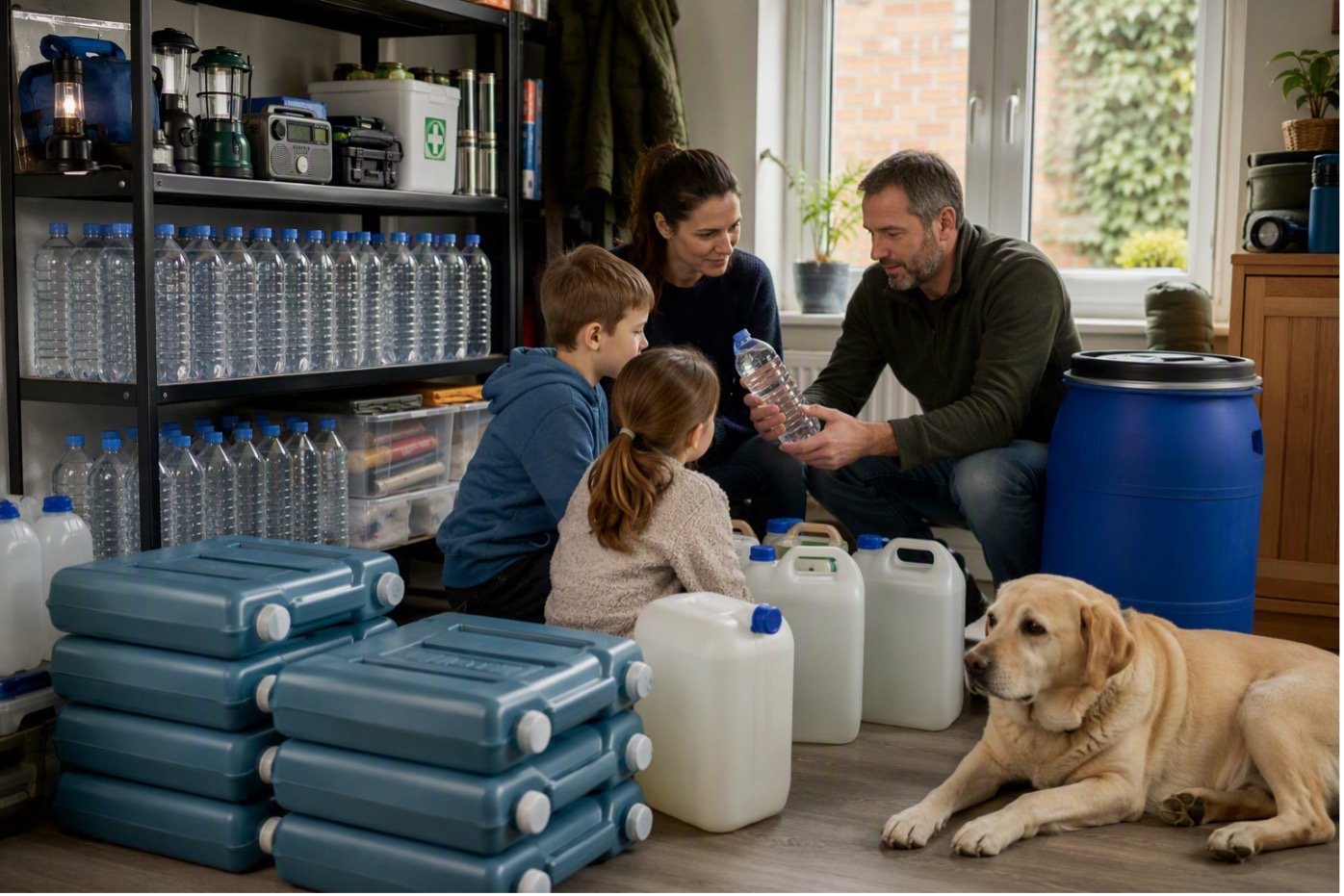
Water is easy to take for granted. Turn on a tap and it's there. Fill a kettle and it boils. Flush a toilet and it disappears. Most of us rarely stop to consider how dependent modern life is on a constant supply of clean water.
Until that supply stops.
Whether the cause is severe weather, a burst water main, flooding, a prolonged power outage, or a wider infrastructure disruption, access to clean drinking water can quickly become one of the most pressing concerns facing a household. Food often dominates preparedness discussions, yet water is the resource that becomes critical first. You can miss a few meals without serious consequences. Water is far less forgiving.
So, how much should you store?
The honest answer is that it depends. Household size matters, but so do temperature, activity levels, health conditions, and even the pets sharing your home. There is no figure that suits everyone. What works for a single person living in a flat may be wholly inadequate for a family with children during a summer heatwave.
A useful starting point is the commonly recommended guideline of four litres per person, per day. That amount is intended to cover drinking, basic food preparation, and minimal hygiene. It does not provide much room for comfort, but it offers a practical baseline from which to plan.
The numbers grow surprisingly quickly.
A single person storing water for a two-week emergency would need around 56 litres. A couple would require approximately 112 litres. For a family of four, the figure rises to 224 litres. Stretch that preparation period to a month and the same family would need close to 500 litres simply to meet basic daily requirements.
That sounds like an enormous quantity of water because it is.
Many people underestimate just how much water they consume each day. Every cup of tea, every glass of squash, every meal cooked on the hob, and every wash of the hands draws from the same supply. Remove the convenience of running water and those daily habits suddenly become far more visible.
Of course, four litres per day should be viewed as a minimum rather than a target. Real life is rarely average. A hot spell in July will increase fluid consumption considerably. Young children may need additional water for cleaning and hygiene. Pregnant or breastfeeding individuals often have higher requirements, and some medical conditions or medications can increase the need for hydration. If you're carrying supplies, clearing debris, walking long distances, or simply spending more time outdoors, consumption can rise quickly.
In those circumstances, many experienced preparedness enthusiasts prefer to plan for six to eight litres per person per day whenever storage space allows. Not because survival demands it, but because comfort, cleanliness, and good hygiene become increasingly important as an emergency drags on. Living through a disruption is one thing. Living through it well is another.
Pets deserve equal consideration.
It's easy to focus on the humans in a household and overlook the four-legged members of the family, but animals rely entirely on us for their water supply. A cat may only drink a few hundred millilitres per day, while a large dog can easily consume two litres or more, particularly in warm weather or following exercise.
Imagine a household of four with a Labrador and a cat. Over a fourteen-day period, the family's basic water requirement sits at around 224 litres. Add the pets and the total pushes beyond 250 litres. Suddenly, those extra containers in the garage don't seem excessive at all.
Once you've decided how much water to store, the next question becomes where to keep it.
For many households, bottled water offers the easiest solution. It requires no preparation, is readily available from supermarkets, and can be incorporated into normal household use through a simple rotation system. Buy a little extra during your weekly shop, consume the oldest stock first, and replace it as you go.
Simple works.
Those seeking a more organised approach often turn to dedicated storage solutions such as food-grade jerry cans, stackable water bricks, or specialist emergency containers. These make far better use of space than individual bottles and allow significant quantities of water to be stored neatly in cupboards, lofts, garages, or under beds.
Larger reserves call for larger containers.
Water barrels, typically holding between 100 and 220 litres, are popular among preparedness-minded households because they provide substantial capacity without requiring dozens of smaller containers. A single barrel can hold nearly a month's worth of emergency water for one person. For families, multiple barrels can form the backbone of a serious water reserve while remaining relatively affordable.
Some households choose to go a step further by harvesting rainwater. In the UK, where rainfall is rarely in short supply, rainwater collection can provide a valuable backup source. However, it's important to remember that collected rainwater should not automatically be considered safe to drink. Filtration, purification, or boiling may still be required before consumption.
That's where redundancy becomes important.
No matter how much water you store, every supply has a limit. The most resilient preparedness plans combine stored water with the ability to obtain and treat additional sources if necessary. Water filters, purification tablets, and the means to boil water provide extra layers of security. If a disruption lasts longer than expected, those capabilities may become just as valuable as the water already sitting on your shelves.
Ultimately, preparedness is not about chasing a perfect number or filling every spare corner of your home with containers. It is about understanding your needs and building resilience gradually. A week's worth of water is better than none. Two weeks is better still. A month of stored water combined with reliable purification methods provides a level of security that very few households possess.
Start small. Build steadily.
Because when systems fail, access to clean water can move from a convenience to a necessity almost overnight. The households that have planned ahead won't just be more comfortable. They'll be far better prepared to face whatever comes next.