

27 October 2026
PowerWhat are you going to do with freezer foods if power goes off?What to Do With Freezer Food When the Power Goes Off: Backup Power and Food Preservation Options
A freezer full of meat and a prolonged power cut can put hundreds of pounds of food at risk. Discover practical ways to keep your freezer running, prepare backup power and preserve meat using traditional methods such as salt curing, smoking and preserving in fat.
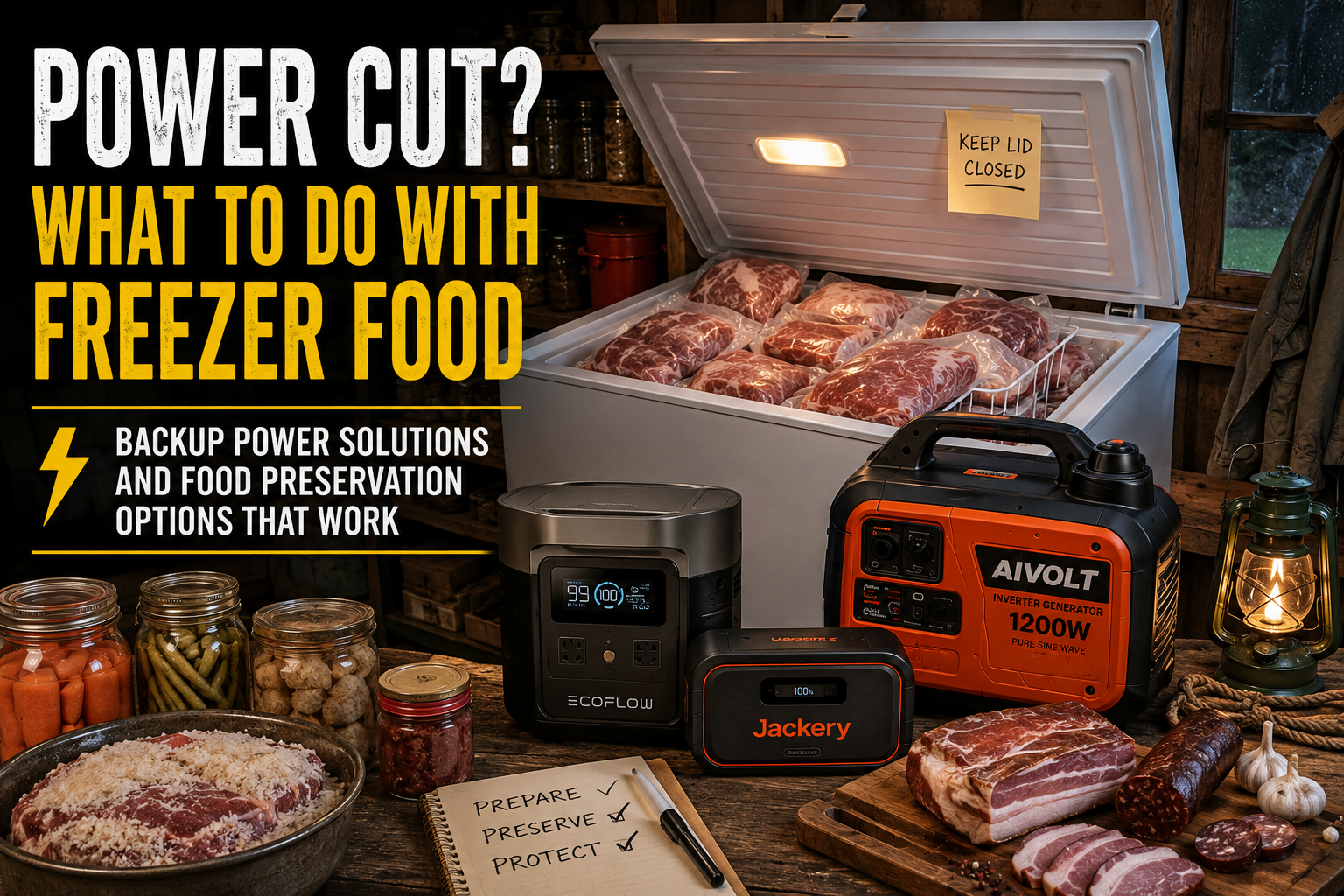
What happens to a freezer full of food when the power goes out?
For many UK households, the freezer is more than a convenient place to store a few ready meals. It might contain several months' worth of food.
Perhaps you buy whole lambs from a local farm, purchase meat in bulk when prices are favourable, grow your own vegetables or batch-cook meals to save money. Whatever your circumstances, a well-stocked freezer represents a considerable investment.
Now imagine a winter storm brings down power lines, or a more serious disruption leaves your home without electricity for several days. The freezer begins to warm, and suddenly you face an awkward question: what are you going to do with all that food?
You could eat it as quickly as possible, share it with family and neighbours, or try to keep the freezer running. If the outage continues, you might need to consider preserving some of the food using methods that don't depend on electricity.
The good news is that there are practical options. Some involve modern technology, such as inverter generators and solar battery systems. Others draw on traditional skills, including salt curing, smoking and drying.
The sensible approach is to prepare for both possibilities: keeping food frozen for as long as possible and having an alternative plan if refrigeration becomes unavailable for an extended period.
How long will food stay frozen during a power cut?
Before buying equipment or planning to preserve your meat, understand how much time you might have.
The UK Food Standards Agency advises that, with the doors kept closed, food in a full freezer may stay frozen for up to 48 hours. A half-full freezer may manage approximately 24 hours. These are estimates, not guarantees, because appliance design, room temperature and how often the door is opened all make a difference.
A fridge is a different matter. It may remain cold for around four hours after the electricity goes off.
For the official guidance, see the Food Standards Agency's advice on food safety during a power cut.
The important lesson is simple: keep the freezer closed and use the available time to make a plan rather than repeatedly checking the contents.
Make your freezer work in your favour
There are several straightforward steps you can take before an emergency.
-
Keep your freezer reasonably full, without blocking vents or exceeding the manufacturer's loading recommendations.
-
Freeze water in suitable containers, leaving enough expansion space. These can act as additional cold mass.
-
Keep an inventory of the contents so you know what is inside without opening the lid.
-
Install a temperature monitor that can alert you when the freezer begins to warm.
-
Keep a suitable thermometer available to assess food if the outage continues.
A full freezer generally retains its cold better than an empty one. Frozen water bottles can help fill spare space, but they are not a substitute for a backup power supply or safe temperature monitoring.
1. Backup power: keep the freezer running
If you regularly buy meat in bulk, a backup power system may be one of the most useful preparedness investments you can make.
The choice depends on how much food you store, how long you expect an outage to last, your budget and whether you have somewhere safe to operate equipment.
Option A: An inverter generator
For many households, a portable inverter generator is a practical way to protect a large quantity of frozen food.
An inverter generator converts engine power into electricity suitable for appliances and can provide a relatively stable supply. However, the generator must be correctly sized for your freezer's running consumption and, crucially, its compressor's starting surge.
Check the freezer manufacturer's specifications and the generator's continuous and surge ratings before purchasing.
One possible strategy is to run the generator periodically rather than continuously. Allow the freezer to cool, switch the generator off and keep the freezer closed while it retains the cold. Monitor the temperature and repeat when necessary.
How often you need to run it will depend on the freezer, how full it is, the surrounding temperature and the condition of the insulation. Test the arrangement before relying on it.
Advantages
-
Can support a freezer and other essential appliances if correctly sized.
-
Can operate for extended periods while suitable fuel remains available.
-
Often a practical option for households storing substantial quantities of meat.
Disadvantages
-
Requires fuel, maintenance and safe storage.
-
Produces noise and exhaust emissions.
-
Needs a suitable outdoor operating location, away from doors, windows and ventilation openings.
Never run a petrol, diesel or LPG generator indoors, in a garage or in another enclosed space. Carbon monoxide can kill. Follow the manufacturer's instructions and use appropriate electrical connections; never backfeed a house circuit through a wall socket.
Fuel storage also needs planning. Keep only permitted quantities in suitable containers and follow UK fire-safety requirements and manufacturer guidance.
Option B: A portable battery power station
Portable power stations from manufacturers such as EcoFlow, Bluetti and Jackery combine a rechargeable battery, inverter and charging inputs in one unit.
They can be useful for keeping a freezer running during shorter outages or as part of a generator-and-battery arrangement.
A battery system is quiet at the point of use, requires little routine intervention and can often be recharged using compatible solar panels. Some models also support charging from a generator or mains electricity.
However, the advertised battery capacity does not tell you exactly how long your freezer will run.
For example, a 1,000Wh battery does not necessarily provide 1,000Wh of usable AC electricity because the inverter consumes some energy. The freezer also cycles on and off and draws extra power when the compressor starts.
A rough estimate is:
Runtime in hours = usable battery energy in Wh ÷ average freezer consumption in watts.
Suppose a system provides 800Wh of usable AC energy and the freezer averages 50W over the period. The theoretical runtime is 16 hours. Actual performance will vary, so treat this as a planning estimate rather than a guarantee.
Check the power station's continuous output, surge capability, usable capacity and compatibility with compressor-driven appliances.
Option C: Solar panels and battery storage
Solar power can be particularly useful if you want to prepare for outages lasting several days.
A battery can supply the freezer overnight, while solar panels recharge it during daylight. A sufficiently large system may also support lights, communications and other essential equipment.
There are two main approaches:
-
Portable solar power station: a self-contained battery with compatible solar charging.
-
Home solar and battery system: a larger installation that may be capable of supplying selected circuits during a power cut.
Do not assume that an ordinary rooftop solar installation will operate during a grid failure. Many systems shut down automatically unless they have suitable backup or islanding functionality.
Winter weather in the UK can also limit solar generation precisely when you might need it most. Size the system around realistic winter output, battery capacity and the freezer's consumption rather than optimistic summer figures.
Option D: A car battery and inverter
A vehicle inverter can be a useful emergency fallback, provided it is correctly specified.
However, a freezer compressor can require a substantial starting surge. A cheap inverter may be unable to start it even if its advertised wattage appears sufficient.
There is also a practical limitation: repeatedly drawing power from a starter battery can leave you unable to start the vehicle.
If you use a vehicle-based solution, research the electrical requirements, use appropriately rated equipment and cables, and test it in advance. A properly designed leisure battery or dedicated battery system is generally more suitable for repeated use.
Never leave a vehicle running in a garage or enclosed space to recharge a battery. Exhaust gases can be fatal.
Option E: An uninterruptible power supply (UPS)
A UPS can automatically provide short-term battery power when the mains fails.
It may be useful for a brief outage or for equipment with a modest power demand. However, many conventional computer UPS units are unsuitable for freezers because they have limited battery capacity or cannot handle the compressor's starting surge.
If you consider this option, choose a model explicitly suitable for the appliance and calculate the likely runtime. A UPS should not be mistaken for a complete solution to a multi-day power cut.
Which backup power option makes the most sense?
| Option | Best suited to | Main limitation |
|---|---|---|
| Inverter generator | Longer outages and substantial freezer loads | Fuel, noise and safe outdoor operation |
| Battery power station | Shorter outages and quiet operation | Limited stored energy |
| Solar plus battery | Repeated or extended outages | Winter solar output and upfront cost |
| Car inverter | Emergency fallback | Starting surge and vehicle battery drain |
| UPS | Brief interruptions | Often insufficient capacity for long outages |
For a household with hundreds of pounds' worth of frozen meat, a tested generator or appropriately sized battery system may be a worthwhile investment. A generator paired with a battery station can also reduce generator running time, provided both systems are compatible.
2. Salt curing: an old skill worth learning
Electricity is a relatively recent development in the history of food storage. Long before domestic freezers existed, people preserved meat using salt, drying, smoking and other methods.
Salt curing works by drawing moisture from the meat and creating conditions that inhibit the growth of many microorganisms.
It can be useful for preserving meat, but it is not simply a matter of covering a joint in salt and leaving it somewhere cool.
Successful curing depends on the cut of meat, its size, the curing method, the ingredients, the time involved and the conditions in which the meat is stored.
Some traditional methods also require controlled drying and careful management of temperature and humidity.
Could you salt-cure a whole lamb?
Potentially, but it is not a skill I would recommend learning for the first time during an emergency.
Large joints present different challenges from thin pieces of meat because salt penetrates at different rates. Some methods require measured curing mixtures, refrigeration during curing, or further drying before the meat becomes suitable for storage.
Nitrite curing salts, where appropriate, must be measured accurately according to a recognised recipe. They are not interchangeable with ordinary table salt.
For a beginner, a safer approach is to learn a tested curing method using a smaller quantity of meat while you still have reliable refrigeration, proper equipment and access to trusted instructions.
Do not assume that salt curing automatically makes meat safe to store at room temperature. The final storage requirements depend on the specific process.
For more information, consult the UK Government's guidance on food preservation at home.
3. Smoking meat: useful, but not a magic solution
If you already own a smoker, you have an additional option worth exploring.
Smoking can improve flavour and, when combined with appropriate curing and drying, contribute to preserving meat. However, the type of smoking matters.
Hot smoking
Hot smoking exposes food to heat and smoke. The process may cook the meat and reduce moisture, depending on the method.
Hot-smoked meat is not automatically shelf-stable. Unless a validated process establishes otherwise, it should be treated as perishable food and stored safely.
Cold smoking
Cold smoking adds smoke flavour without cooking the meat. It is normally used with an appropriate curing process, and the resulting food may still need refrigeration unless it has undergone a suitable additional preservation process.
Cold smoking raw meat during a power cut is not a reliable way to rescue food that has already warmed beyond safe limits.
Learn the process before you need it
If smoking is part of your preparedness plan, practise with small batches, suitable equipment and a recognised recipe.
Understand how to manage the process and how the finished product should be stored. Do not rely on colour, appearance or smoky flavour to judge whether meat is safe.
A smoker is a valuable tool, but it should form part of a wider food-preservation plan rather than being your only answer to a prolonged outage.
4. Preserving meat in fat
Another traditional method is to cook meat slowly and store it submerged in rendered fat. A well-known example is confit.
The method can produce delicious food and may extend its useful life under the right conditions. However, storing cooked meat beneath a layer of fat does not make it safe for long-term storage at room temperature.
Fat can exclude some air, but it does not reliably eliminate the microorganisms or bacterial spores that cause foodborne illness. Some dangerous toxins may develop without obvious changes in smell or appearance.
Traditional confit recipes often rely on refrigeration or other controlled storage conditions.
If you want to learn this technique, do so as a cooking and food-storage skill, following a tested recipe and its refrigeration requirements. Do not treat it as a substitute for a properly validated shelf-stable preservation process.
5. Pressure canning: a longer-term option
Pressure canning is worth researching if your aim is to store meat for long periods without relying on a freezer.
Meat is a low-acid food, so ordinary boiling-water bath canning is not a safe substitute for a validated pressure-canning process.
Pressure canning uses controlled pressure, temperature and processing time to achieve the required treatment throughout the food. The precise procedure depends on the food, container, preparation method and equipment.
This is not a task to improvise during a power cut. If your equipment depends on electricity, you will also need to consider whether it can be operated safely and effectively during an outage.
If long-term canned meat is part of your preparedness strategy, practise beforehand with suitable equipment and trusted instructions. Keep a stock of commercially canned meat as a simpler backup.
The principle is straightforward: use a recognised, tested process, follow it exactly and do not take chances with food that may have been preserved incorrectly.
6. What should you do when the freezer starts to thaw?
Despite your best preparations, you may eventually face a situation where the freezer is warming and you cannot restore the power.
At that point, the priority is to assess the food safely and minimise waste without taking unnecessary risks.
Step 1: Check the temperature and condition
Use your temperature monitor and assess whether food is still frozen, contains ice crystals or has thawed completely.
Do not rely on the number of hours since the power failed alone. Two freezers in different homes may warm at very different rates.
Step 2: Prioritise food that needs using first
Think about the food in your fridge as well as the freezer.
Chilled foods and perishable items may need attention before food that remains frozen. Use the Food Standards Agency's guidance to decide what can safely be kept, cooked, refrozen or discarded.
Do not taste food to determine whether it is safe. Smell and appearance cannot reliably identify dangerous contamination.
Step 3: Cook suitable food if you can do so safely
If the food is still safe to use, cooking it may help you manage the situation. However, cooking is not a way to make food safe after it has been temperature-abused, and it does not reliably destroy every toxin that may have formed.
You will also need a safe way to cook without mains electricity, such as a suitable outdoor camping stove or other correctly operated appliance.
Never use outdoor cooking equipment indoors because of the risk of carbon monoxide poisoning and fire.
Step 4: Share food where appropriate
If food remains safe, sharing it with family, neighbours or friends may reduce waste.
However, do not pass on food of uncertain safety simply because you cannot use it yourself.
Step 5: Don't attempt to preserve unsafe meat
This is particularly important when considering salt curing, smoking, drying or preserving in fat.
These processes should begin with suitable, safely handled ingredients. They are not emergency treatments for meat that may already have become unsafe.
7. Build a freezer emergency plan before the next power cut
The best time to decide what to do with a freezer full of food is while the electricity is working.
Start with a simple plan.
Know what you have. Keep a written or digital inventory of the meat and other food in your freezer. Record approximate quantities and identify which items you would use first.
Know how long your freezer holds its temperature. Check the manufacturer's guidance and, if practical, conduct a controlled test using a temperature logger. Do not put food at risk simply to experiment.
Choose your backup power option. Calculate the freezer's energy requirements and starting surge. Decide whether a generator, battery station or combination of the two suits your circumstances.
Keep the necessary supplies. This may include compatible cables, a suitable thermometer, generator maintenance supplies and fuel stored in accordance with safety requirements.
Learn one preservation method properly. Rather than attempting to master every traditional technique, start with one suitable method and practise it before an emergency.
Keep food that does not need freezing. Tinned foods, dried pulses, rice, pasta and other cupboard staples reduce your dependence on refrigeration. They also provide alternatives if you cannot use the contents of your freezer.
Consider your wider preparedness needs. In a prolonged power cut, keeping warm, maintaining communications and accessing safe drinking water may be just as important as preserving your food.
Final thoughts: modern backup power and traditional skills belong together
A freezer full of meat is an asset, but it also creates a dependency on electricity.
For households that buy whole lambs or other meat in bulk, losing that food could mean a significant financial loss as well as a disruption to everyday meals.
A generator, a suitably sized battery system or a solar-and-battery installation can help protect that investment. Temperature monitoring and a clear plan make those options more effective.
Traditional food-preservation skills are valuable too. Salt curing, smoking and pressure canning each have a place in a long-term preparedness strategy, provided they are learned and carried out correctly. Preserving meat in fat can be useful for cooking and short-term storage under the right conditions, but it must not be mistaken for a reliable room-temperature preservation method.
My recommendation is to combine the approaches. Keep your freezer running for as long as you safely can, maintain a supply of food that does not require refrigeration, and learn preservation techniques before you need them.
Preparedness is not about finding one perfect solution. It is about having several workable options when circumstances change.
Stay prepared. Stay practical. Stay safe.
Further reading
Suggested internal links for UKPrepper.me
Add contextual links to your existing articles where relevant:
-
How to Prepare for a Power Cut in the UK — What to consider planning for a powercut.
-
UK Emergency Kit: What Should You Include? — Things to consdier for your home and car emergency kits.
-
Cooking Without Electricity in the UK — advice about cooking food during an outage.
-
Is the UK's 72-Hour Emergency Food and Water Advice Enough? — The UK Government is adcising citizens to store at least 3 days of food and water for an emergency; is this enough? And how to slowly build larger supplies.
-
Emergency Cash at Home in the UK — learn how to build an emergency cash supply at home in case of a major power outage or SHTF situation.