

7 November 2026
PowerPortable Power Banks, Solar Panels and Power Stations: A UK Prepper’s Guide
Discover how portable power banks, folding solar panels and battery power stations can help UK preppers stay connected during power cuts and emergencies. Compare Jackery, Anker SOLIX and EcoFlow, explore backup power options for phones, lighting and essential devices, and learn how to choose a setup that suits your budget.
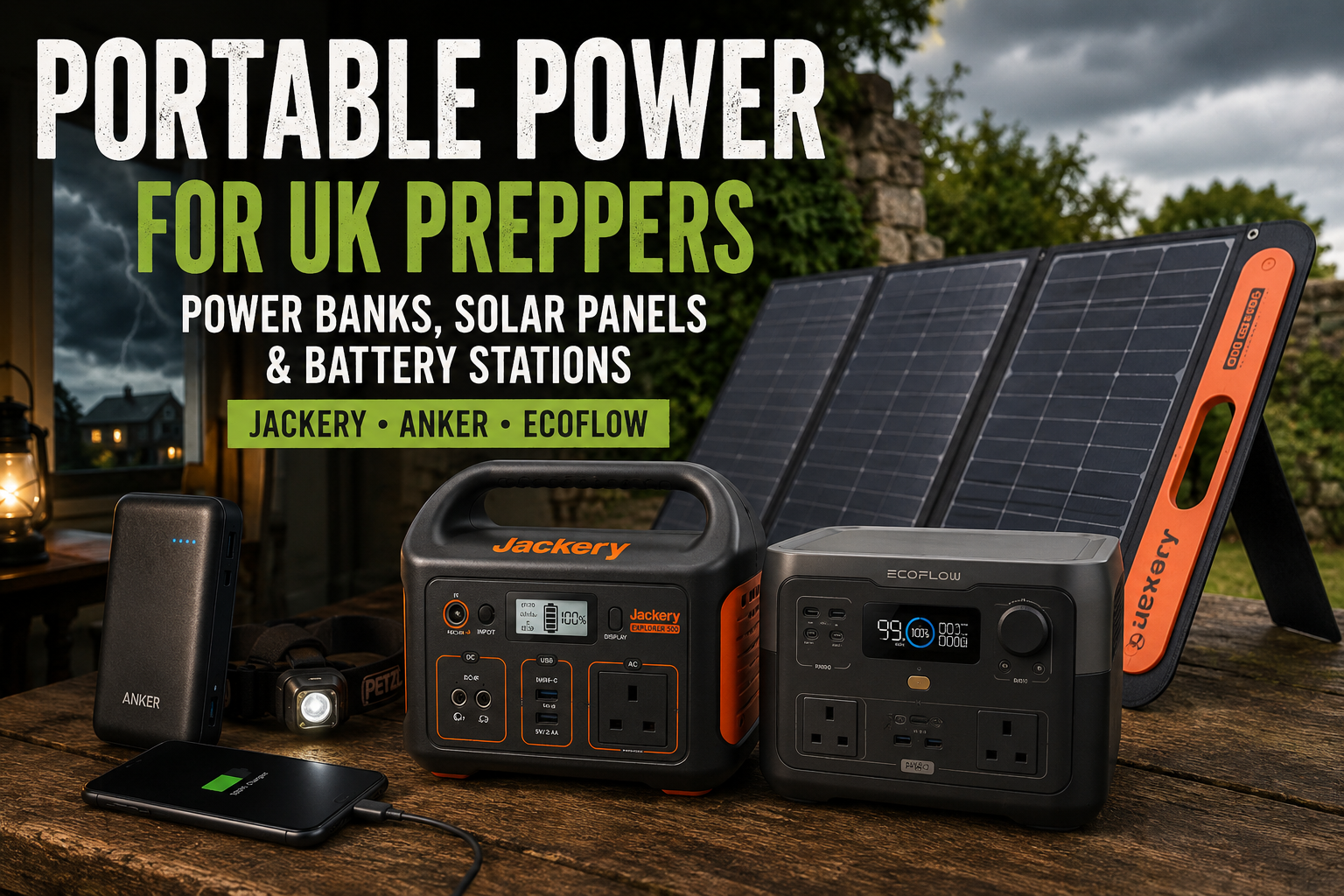
Imagine a winter evening in the UK. The electricity has gone off, the house is getting colder, mobile phone batteries are running low, and you have no idea when the power will return.
For a short interruption, a charged mobile phone and a torch might be enough. But what happens when a power cut lasts overnight, continues into the next day, or affects a wider area?
This is where portable power becomes an important part of a sensible preparedness plan.
Fortunately, preparing for a power cut does not have to mean buying an expensive generator or installing a whole-house battery system. There are several options available, from inexpensive USB power banks to folding solar panels and substantial battery power stations capable of running selected household appliances.
Brands such as Jackery, Anker SOLIX and EcoFlow have made portable power increasingly accessible. The challenge is working out which equipment is genuinely useful, rather than spending money on features you may never need.
In this guide, we will look at the different options, what they can realistically power, and how to build a portable power system that makes sense for your home, vehicle, camping trips or emergency kit.
1. Portable power banks: The first line of defence
A conventional USB power bank is probably the most affordable and practical starting point for most preppers.
These compact batteries store electricity and allow you to recharge phones, tablets, head torches and other USB-powered devices without relying on a wall socket.
They are particularly useful because communications are often among the first things people worry about during a power cut. Your phone might provide access to emergency alerts, local news, maps, family contacts and information about the disruption.
A power bank cannot guarantee that mobile networks will remain operational, but it can help keep your own equipment charged while those services are available.
What capacity should you buy?
Power banks are commonly advertised in milliamp-hours (mAh). This figure is useful for comparing products, although it does not tell the entire story because voltage conversion and charging losses reduce the energy delivered to your devices.
As a general guide:
-
5,000–10,000mAh: A compact option for a small emergency bag or everyday carry.
-
20,000mAh: A useful all-round capacity for several phone recharges, depending on the phone and charging losses.
-
25,000–27,000mAh: A higher-capacity option that may suit longer trips and charging multiple devices. Check airline restrictions if travelling.
-
Multiple power banks: Useful for a family, allowing each person to have a dedicated supply rather than sharing one battery.
For preparedness, I would rather have two dependable power banks charged and ready than one large unit that has been left in a drawer for six months.
Recommended product: Anker power banks
Anker is a well-established name in portable charging. Its PowerCore and newer high-capacity USB-C models offer options for people who want a compact backup supply without carrying a full power station.
Look for USB-C Power Delivery (PD), particularly if you need to charge newer phones or a compatible laptop. Higher output wattage can make a significant difference to charging speed.
Product link: Shop Anker power banks on Amazon UK
What should you charge first?
During a prolonged outage, think about priorities rather than charging everything simply because you can.
-
Mobile phones and essential communication devices.
-
Rechargeable torches and head torches.
-
Essential medical or accessibility equipment, using an appropriate and verified power source.
-
Tablets, radios and other useful electronics.
-
Entertainment devices, if spare capacity remains.
Keep one power bank reserved for emergencies rather than allowing every battery to become depleted at the same time.
2. Solar power banks: Useful, but understand their limitations
Solar power banks are marketed as a way to recharge devices using sunlight. Some incorporate a small solar panel directly into the casing, while others can be connected to a separate folding panel.
The idea is appealing: if the electricity supply fails, the sun can provide another source of energy.
However, there is an important distinction between a small solar panel built into a power bank and a dedicated portable solar panel.
The tiny panels fitted to many solar power banks generally produce very little electricity. They may help maintain a charge under favourable conditions, but they are rarely a dependable way to recharge a depleted battery quickly.
For UK preparedness, particularly during winter, I would treat the built-in panel as a supplementary feature rather than the main charging method.
A separate folding solar panel is usually a more practical choice if you intend to harvest meaningful amounts of solar energy.
When does a solar power bank make sense?
It can be useful for walking, camping, day trips and emergency bags where weight and convenience matter more than charging speed.
Choose a model with a good-quality battery, reputable safety features and USB charging. If the solar panel is the main selling point, check its actual rated output rather than relying on promotional photographs or claims about charging in sunlight.
For a more capable system, pair a conventional power bank with a separate solar charger, or use a portable power station designed for solar input.
Product link: Browse solar power banks on Amazon UK
3. Folding solar panels: Turning daylight into useful power
Portable solar panels are a logical next step when you want to recharge batteries away from the mains.
These panels are designed to unfold or stand on a support, allowing you to position them towards the sun. Many connect to a compatible portable power station, while smaller USB models can charge suitable devices directly.
They are useful for camping, caravanning, remote working, off-grid trips and emergency preparedness.
The main advantage is flexibility. A power bank stores electricity you have already charged, whereas a solar panel can replenish your supply when conditions allow.
Is 100W enough?
A 100W folding solar panel is a sensible starting point for many small portable power setups.
Under suitable conditions, it may provide enough energy to recharge phones, maintain a supply of lighting and gradually replenish a small power station. However, the advertised 100W is a peak rating, not a guarantee of continuous output.
In the UK, solar generation varies considerably with season, cloud cover, panel orientation, shading and the length of the day. A panel that performs well on a clear summer afternoon may produce very little during a dark winter morning.
Larger panels, such as 200W or 400W models, can collect more energy in suitable conditions, but they cost more, take up more space and may be heavier to transport.
Jackery SolarSaga panels
Jackery's SolarSaga range is designed to work with compatible Jackery Explorer power stations. Depending on the model, panels are available in different sizes and folding formats.
For a small emergency setup, a 100W-class panel can be a useful compromise between portability and output. Larger panels may be preferable if you intend to recharge a higher-capacity battery regularly.
Product links:
EcoFlow portable solar panels
EcoFlow offers portable folding panels intended for compatible power stations. Its range includes lighter panels for smaller setups and larger models for users who need to harvest more energy.
The most important consideration is not simply buying the highest-wattage panel you can afford. It is choosing a panel that is compatible with your battery station and practical for your available space.
Product links:
Anker SOLIX solar panels
Anker SOLIX also offers portable solar charging products designed to complement its battery stations.
These may suit people who want to build a matched system from one manufacturer. Compare the panel's rated output, weight, weather resistance and compatibility with the specific power station before buying.
Product link: Anker SOLIX portable solar panels on Amazon UK
A practical warning about solar charging
Do not assume that every solar panel will work with every power station. Voltage ranges, connectors and maximum solar input vary between models.
Check the manufacturer's compatibility guidance before purchasing. Also remember that portable panels are not necessarily designed to be left outside permanently, even when described as weather-resistant. Follow the instructions for the specific product.
For emergency planning, it is best to recharge a battery from mains electricity before an anticipated outage and use solar to extend your reserves afterwards.
4. Portable battery power stations: A bigger step up
A portable power station is essentially a rechargeable battery system with built-in charging electronics and various output connections.
Depending on the model, these may include USB-A, USB-C, 12V DC and standard UK mains sockets. Some can be recharged from a wall socket, a vehicle or compatible solar panels.
Unlike a conventional USB power bank, a power station with an AC inverter can run selected mains-powered equipment.
This opens up more possibilities during a power cut.
A suitably sized unit might power:
-
Mobile phones and tablets.
-
LED lamps and rechargeable lights.
-
A Wi-Fi router, provided the internet connection itself remains operational.
-
Laptops and other low-power electronics.
-
Selected small appliances, provided their power requirements fall within the station's limits.
Some larger units can support higher-demand appliances, but this depends on both battery capacity and output capability.
A power station is not automatically a replacement for a home generator, nor can every model run a kettle, microwave, electric heater or refrigerator. Those appliances can consume substantial energy, and some have high starting-power requirements.
Understanding watt-hours and watts
Two figures matter when comparing battery stations.
Watt-hours (Wh) describe how much energy the battery stores. A 1,000Wh battery stores approximately 1kWh of energy.
Watts (W) describe how much power the unit can supply at a given moment. A station with a 1,000W continuous output rating may be able to run a suitable 800W appliance, but not a 1,500W appliance.
The actual runtime depends on the appliance's consumption, inverter losses, battery condition and other factors.
For example, a 1,000Wh battery running a device that consumes 50W might theoretically provide 20 hours of operation. Real-world runtime will be lower when conversion losses and other factors are considered.
This is why choosing a battery station solely by its advertised output can be misleading. You need sufficient stored energy as well as adequate output power.
5. Jackery: A straightforward approach to portable power
Jackery is a popular choice among campers, van owners and people looking for portable emergency electricity.
Its Explorer power stations are available in a range of capacities, from compact models suitable for charging electronics to larger units designed for longer trips and more demanding equipment.
Many can be recharged from mains electricity, a vehicle or compatible SolarSaga panels. The exact options depend on the model.
Who should consider Jackery?
Jackery is worth considering if you want a relatively straightforward portable power setup for camping, occasional power cuts or basic household preparedness.
A smaller Explorer model may be sufficient for phones, lighting and a laptop. A larger model can provide more stored energy for running several devices or supporting selected appliances for longer.
Before buying, compare the capacity in Wh, continuous AC output, number and type of sockets, solar input limits, battery chemistry, weight and warranty.
Browse the range:
Treat these as product searches rather than guarantees that every model or bundle is currently available. Check the exact specification and version before ordering.
6. Anker SOLIX: Portable power with a broad product range
Anker is already familiar to many people through phone chargers and power banks. Its SOLIX range extends that experience into larger battery power stations and portable solar charging.
The range includes compact units for electronics and larger models for users who need more energy storage or higher AC output.
One advantage of looking at a manufacturer's wider ecosystem is that you may be able to build a system around compatible batteries, panels and accessories. However, compatibility should always be checked at model level rather than assumed from the brand name.
Who should consider Anker SOLIX?
Anker SOLIX is worth comparing if you want a system that can grow from charging phones and laptops to supporting a wider selection of essential devices.
For many households, a power station in the 500Wh to 1,000Wh class is a useful starting point for research. It can offer a balance between portability, stored energy and cost, although the right size depends on your actual loads.
If you expect longer outages or want to run higher-demand equipment, investigate larger capacities and expansion options. Do not confuse a high output rating with long battery life.
Browse the range:
Check whether the model has the AC sockets, USB-C output and solar charging capability you need. Also look at its continuous and surge ratings before planning to run anything with a motor or compressor.
7. EcoFlow: Portable power for more demanding setups
EcoFlow is another major name in portable power, with its RIVER and DELTA families covering different requirements.
Broadly speaking, smaller RIVER models are worth investigating for camping, electronics and lighter backup duties, while larger DELTA models are designed for greater energy storage and higher output.
Depending on the specific product, features may include rapid mains charging, app-based monitoring, solar input and expandable battery capacity.
These features can be useful, but the best choice still comes down to the equipment you need to power and the length of time you need to run it.
Who should consider EcoFlow?
EcoFlow is worth a look if you want a portable battery station that can serve several roles: camping, mobile working, emergency lighting, communications and selected household backup tasks.
For example, a compact unit may keep a laptop and router operating for a period, while a larger unit could provide more flexibility for multiple devices or a longer interruption.
A larger battery does not eliminate the need to manage energy. If you use high-powered appliances continuously, even a substantial portable station can be depleted surprisingly quickly.
Browse the range:
As with Jackery and Anker, model specifications and bundles change over time. Check the exact product listing, included cables, solar input limits and warranty before making a decision.
8. Jackery vs Anker SOLIX vs EcoFlow: Which should you choose?
There is no single winner for every prepper. The best option depends on your budget, energy needs and how portable the equipment must be.
| Consideration | Jackery | Anker SOLIX | EcoFlow |
|---|---|---|---|
| Compact emergency power | Explorer range includes smaller options | Compact SOLIX models available | RIVER range includes smaller options |
| Larger battery stations | Explorer range includes higher capacities | SOLIX range includes larger units | DELTA range includes larger units |
| Solar charging | Compatible SolarSaga panels and other supported charging options | Compatible SOLIX solar panels and supported inputs | Compatible EcoFlow panels and supported inputs |
| What to compare | Capacity, output, weight and charging | Capacity, output, ports and charging | Capacity, charging speed, output and expansion |
| Best approach | Match the station to your essential devices | Match the station to your required output and future needs | Match the station to your loads and preferred charging options |
This is a broad comparison of product families, not a claim that every product has the same features or performance.
Rather than choosing a brand first, write down what you need to power, how many hours you need it for and how you will recharge the battery. Then compare individual models against that list.
9. How much portable power do you really need?
Before spending several hundred pounds on a power station, work out your likely electricity requirements.
Start by listing the devices you would consider essential during a power cut. Check their labels, manuals or manufacturer's specifications to find their typical wattage or energy consumption.
For devices rated in watts, a useful first estimate is:
Energy required (Wh) = power consumption (W) × hours of use
For example, if a 10W device runs for five hours, it consumes approximately 50Wh before conversion losses.
Here is an illustrative guide to how different battery sizes might fit into a preparedness plan.
| Battery capacity | Possible role |
|---|---|
| 100–200Wh | Phones, small lights and limited electronics use |
| 250–500Wh | Several small devices, lighting and some laptop charging |
| 500–1,000Wh | A broader selection of electronics, router use and longer lighting periods |
| 1,000–2,000Wh | More flexibility for multiple devices and selected small appliances |
| 2,000Wh or more | Larger reserves for carefully planned essential loads |
These are planning categories, not guaranteed runtimes. Actual performance varies with the model, output method, battery condition and devices being used.
A power station with 1,000Wh of stored energy will not necessarily deliver 1,000Wh through its AC sockets. Inverter losses and the unit's own consumption reduce usable energy.
For a more accurate estimate, total the energy required by your planned devices, allow for losses and add a reasonable reserve.
10. Can a portable power station run a fridge, kettle or electric heater?
This is where it pays to be realistic.
A kettle or electric heater can draw a great deal of power. Even if a power station has sufficient output to run the appliance, its battery may be exhausted quickly.
Refrigerators present a different challenge. Their average energy consumption can be modest compared with a kettle, but compressors have starting surges, and consumption varies with ambient temperature, the appliance and how often its door is opened.
Always check both the station's continuous output and its surge capability. For a fridge, consult the manufacturer's electrical specifications and allow for starting demand.
If your main goal is to keep food safe during a prolonged power cut, a power station may help, but it should be considered alongside keeping the refrigerator or freezer closed, monitoring food temperatures and having a plan for food that cannot be kept safely chilled.
Do not assume that a small battery station will keep a full-size freezer operating for days without recharging.
11. Building a practical solar and battery setup
For many UK households, a layered approach makes more sense than relying on one expensive product.
Consider building your system in stages.
Stage one: Basic communications
Start with two reliable power banks, charging cables, a head torch and a rechargeable or battery-powered radio.
Keep the power banks charged and store the kit where everyone in the household can find it.
Stage two: Add a portable power station
Choose a station sized around your actual needs. This might mean a compact unit for laptops and lighting or a larger battery if you want to support additional equipment.
Before buying, check the weight. A large unit may be excellent for home backup but less useful if you intend to carry it on foot.
Stage three: Add solar charging
Choose a compatible folding panel and learn how to set it up before an emergency.
Test it on a normal day. Find out how long it takes to recharge your station in realistic UK weather, how the cables connect and where you can safely position the panel.
Stage four: Improve your energy management
Reduce unnecessary consumption by using LED lights, switching off devices that are not needed and charging equipment in a planned order.
For longer outages, consider whether a second battery, additional compatible panels or a different charging method would provide more benefit than simply buying a bigger station.
Remember that solar charging is weather-dependent. Keep your batteries charged before a forecast outage rather than relying on sunshine appearing when you need it.
12. Battery safety, storage and maintenance
Portable batteries are valuable emergency equipment, but they need sensible care.
-
Follow the manufacturer's charging, storage and operating instructions.
-
Use compatible chargers, cables and solar panels.
-
Keep batteries away from excessive heat, moisture and physical damage.
-
Do not use equipment with a swollen casing, damaged wiring or signs of overheating.
-
Store equipment in a dry, suitable location and check its charge periodically.
-
Test your power station and accessories before relying on them in an emergency.
-
Keep the equipment's manuals and essential cables together.
Many modern power stations use lithium iron phosphate (LiFePO4) batteries, while others use different lithium-ion chemistries. LiFePO4 batteries are often designed for a high number of charge cycles, but cycle-life claims depend on operating conditions and the manufacturer's testing criteria.
Check the chemistry and the specified storage and maintenance requirements for the exact model.
Never use a portable battery station or its charging equipment in a way that exposes it to rain or other conditions outside its rated protection. Do not attempt to connect a portable power station to your home's fixed wiring through a wall socket. Household circuits require appropriate, professionally installed transfer equipment and electrical safeguards.
If you rely on powered medical equipment, consult the equipment provider and relevant healthcare professionals about an appropriate backup plan. Do not assume a consumer power station is suitable without checking its compatibility and runtime.
13. What about a portable generator?
Battery power stations and fuel-powered generators serve different purposes.
A battery station is generally quieter, produces no exhaust at its point of use and can be convenient for indoor use when operated according to its instructions. It stores a finite amount of electricity, however, and must be recharged.
A fuel-powered generator can supply electricity for longer if you have adequate fuel, but it creates dangerous exhaust gases and must be operated outdoors, well away from doors, windows and ventilation openings, in accordance with its instructions.
Never run a petrol, diesel or gas generator indoors, in a garage or in another enclosed or partially enclosed space. Carbon monoxide can kill.
For many households, a small battery station is a convenient way to keep essential electronics running, while a generator may be relevant to a different set of needs. Neither should be purchased without considering safety, maintenance, fuel or charging arrangements.
14. Common mistakes when buying portable power equipment
Buying capacity without checking output. A large battery may still be unable to run an appliance that exceeds its inverter rating.
Assuming advertised solar wattage is guaranteed. Panel output depends on sunlight, orientation, temperature and other conditions.
Ignoring compatibility. A panel with the wrong voltage range or connector may not work with your power station.
Forgetting the cables. A panel or station is of little use if you lack the correct charging lead or adapter.
Leaving everything untested. Find out how your kit works while the mains supply is available, not during a blackout.
Expecting a battery to run the whole house. Most portable units are intended for selected loads, not unrestricted household use.
Buying the largest model immediately. A carefully planned smaller system may be more useful and affordable than an oversized battery you rarely move or recharge.
Failing to plan for winter. Solar generation can be limited precisely when prolonged darkness and poor weather make backup electricity most valuable.
Conclusion: Build a power system that matches your needs
Portable power banks, folding solar panels and battery power stations can all make a useful contribution to UK emergency preparedness.
Power banks are a low-cost way to protect communications and keep small devices running. Folding solar panels can extend your reserves when conditions are favourable. Larger battery stations from Jackery, Anker SOLIX and EcoFlow offer more flexibility for laptops, lighting, routers and selected appliances.
You do not need to buy everything at once. Start by identifying the equipment you cannot afford to have without power, calculate how much energy it needs, and build a system around those priorities.
For many households, a sensible first step is a pair of dependable power banks, a good LED head torch and a clear charging plan. A portable power station can follow when your budget allows, with solar added if you have the space and conditions to use it effectively.
The goal is not to power every appliance in your home indefinitely. It is to maintain the essentials, stay informed and give yourself more options when the electricity supply fails.
That is what practical preparedness is all about.
Other articles you might find interesting:
Building a Household Blackout Box: Practical Resilience for Everyday Life
Preparing for a 14-Day Blackout in the UK: What You Really Need to Stock