

26 October 2026
General PreppingPreparing for a 14-Day Blackout in the UK: What You Really Need to Stock
Could your household cope with a 14-day power cut? Discover how to prepare for an extended UK blackout with practical advice on water, food, cooking, warmth, lighting, sanitation and emergency communications.
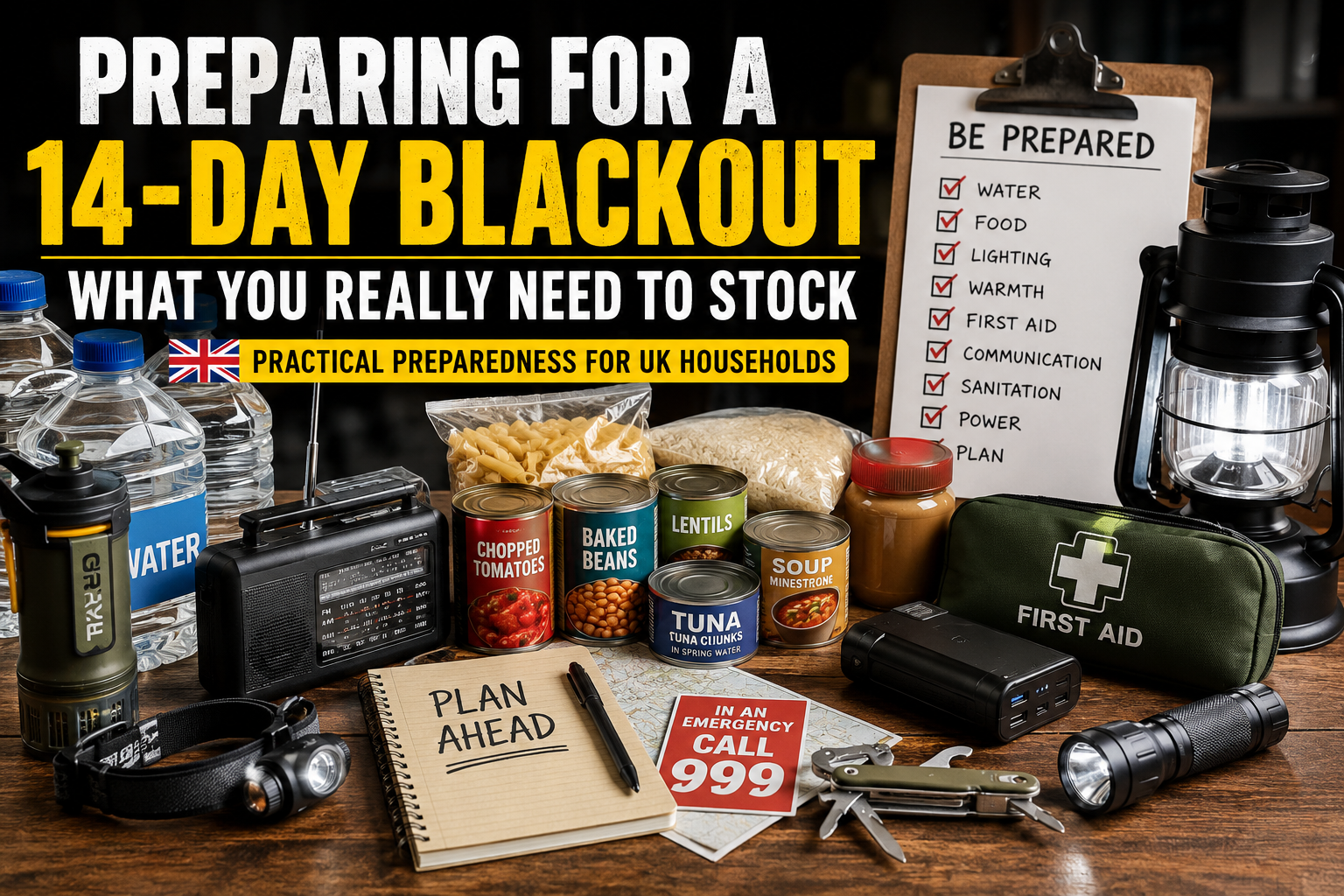
The UK government advises households to prepare for emergencies, including disruption to essential services. But while having supplies for the first few days is an excellent starting point, have you thought about what happens if the power stays off for a week? Or two?
An extended blackout changes the situation considerably. It isn't simply a case of finding a torch and eating a few tins from the cupboard. Depending on the circumstances, you could face disruption to water supplies, heating, cooking, mobile communications, internet access and the ability to buy everyday essentials.
So, how do you prepare for a 14-day blackout in the UK without filling every cupboard with expensive survival equipment?
The answer is to prioritise the essentials, understand what your household depends on, and build a practical plan that works for your budget and available storage space.
In this guide, we'll look at what really matters when preparing for an extended power cut, from water filtration and food storage to warmth, sanitation, backup power and keeping the family occupied.
Why prepare for more than three days?
Official emergency guidance provides a sensible starting point. However, the duration of a real emergency is not something any of us can guarantee.
Severe weather, infrastructure damage, technical failures or other major incidents could cause disruption that takes time to resolve. Even when electricity returns, other services may not immediately return to normal.
A 14-day blackout is a planning scenario, not a prediction that the UK will experience a nationwide two-week outage. Preparing for one helps you think through what your household would need if normal services remained unavailable for an extended period.
The aim isn't to panic-buy or spend hundreds of pounds overnight. It is to reduce your reliance on shops, mains services and outside assistance while maintaining a reasonable level of comfort and safety.
The essentials: think beyond a shopping list
There is no single blackout kit that suits every household. A family living in a small flat will have different requirements from someone with a large garden, a wood-burning stove and plenty of storage.
Instead of starting with a list of products, think about the problems you need to solve.
-
Where will your drinking water come from?
-
What will you eat when the fridge and freezer stop working?
-
How will you prepare meals and boil water?
-
How will you stay warm during a winter power cut?
-
What will happen if the toilets stop working properly?
-
How will you receive emergency information and contact family?
-
Does anyone in your household depend on powered medical equipment?
-
How will children cope without their usual entertainment?
Answering these questions gives you a much better starting point than buying equipment simply because it appears on a preparedness checklist.
1. Water: your number-one priority
Water is one of the easiest essentials to overlook when building an emergency food supply. Tins of food can sit in a cupboard for months, but water is needed every day for drinking, preparing meals, basic hygiene and cleaning.
It also becomes particularly important when you rely on foods that need rehydrating.
Storing water in a typical UK home
Space is a major challenge for many UK households. Storing enough water for two weeks can be difficult, especially if you live in a flat or have a busy family home.
Start by keeping a supply of commercially bottled water or water in suitable, clean, food-grade containers. Store it according to the manufacturer's guidance and check containers periodically.
Work out your requirements based on the number of people in your household, your planned duration and the conditions you might face. You will need more water in hot weather, during physical activity or if someone has additional medical needs.
Remember that drinking water is only part of the calculation. Cooking, washing hands and other basic hygiene tasks also require water.
Water filtration: useful, but not a substitute for safe water
If you cannot store everything you might need, a suitable water filter can provide an additional layer of resilience. Portable filters, gravity-fed systems and purifier bottles all have different advantages.
However, not every water filter makes contaminated water safe to drink. Some remove particles and certain microorganisms but do not reliably remove viruses, chemicals or other contaminants.
Before buying one, check exactly what it is designed to remove and whether it is suitable for the water sources you might encounter.
Where possible, use known safe water sources. Follow current public-health advice if mains water is declared unsafe. Boiling can kill many disease-causing microorganisms, but it will not remove chemical contamination or every possible hazard. A filter and boiling may address different risks, so understand the limitations of your equipment.
Rainwater, rivers, streams and lakes should not automatically be assumed safe to drink, even after basic filtration.
Think about carrying water, too
Having access to water is only useful if you can get it home.
Collapsible water containers can be convenient for transporting supplies and take up relatively little room when empty. Choose robust containers with secure closures and handles, and consider who in your household will actually be able to carry them.
Ten litres of water weighs approximately 10 kilograms, before adding the weight of the container. Plan accordingly, especially if children, older relatives or anyone with limited mobility will be involved.
Practical takeaway: Start with stored drinking water, then consider filtration, safe treatment methods and transport. Don't rely on a filter as your only water plan.
2. Food: stock what you actually eat
Emergency food doesn't have to mean military rations, expensive freeze-dried meals or a cupboard full of unfamiliar products.
In fact, one of the best ways to prepare is to build a sensible reserve of food you already eat.
Think about your normal meals. What would you prepare if you couldn't use your usual appliances? Which cupboard ingredients would still be useful without refrigeration? What could you feed the family if shopping became difficult for a fortnight?
Good starting points include:
-
Tinned beans, chickpeas, lentils and vegetables.
-
Tinned soups and ready-to-eat meals.
-
Tinned fish or other suitable protein sources.
-
Oats, crackers, cereal and long-life bread products.
-
Rice, pasta and other staples, provided you can cook them safely.
-
Long-life milk or suitable alternatives.
-
Dried fruit, nuts and snacks.
-
Food for babies, pets or anyone with specific dietary needs.
Choose foods that suit your household, including any allergies or dietary requirements. Rotate your supplies by using older products first and replacing them during ordinary shopping trips.
What about freeze-dried food and MREs?
Freeze-dried meals and military-style meals ready to eat (MREs) can be useful options, particularly when storage space is limited.
Freeze-dried meals can be compact and have a long shelf life when stored correctly. But many require water for rehydration, so that water must be included in your calculations.
MREs can provide convenient meals with minimal preparation. However, prices and nutritional content vary, and buying a large box without trying the meals first can leave you with supplies nobody wants to eat.
Try a few individual meals before investing in bulk quantities. Check the manufacturer's storage instructions, expiry or best-before information, and any heating requirements.
These products are options rather than necessities. A well-managed cupboard of ordinary food can be a perfectly sensible foundation.
Don't forget the can opener
It sounds obvious, but it is worth checking. If most of your emergency food comes in tins, keep at least one reliable manual can opener with your supplies. A spare is useful.
You don't want to discover that your opener has broken when the electricity is off and the kitchen lights aren't working.
3. Cooking and boiling water without mains electricity
Food you can eat cold is valuable during a power cut, but the ability to heat a meal and boil water gives you more options.
A hot drink, warm meal or bottle of hot water can make a difficult evening considerably more comfortable.
A camping stove may be useful if you choose one suitable for your intended use. However, there is an important safety point: never use a camping stove or outdoor barbecue inside your home, in a tent or in another enclosed space. These appliances can produce carbon monoxide, an odourless and potentially fatal gas.
Follow the manufacturer's instructions and use fuel-burning equipment only in the locations and conditions it is designed for. Keep it away from combustible materials, and store fuel safely.
Alternative approaches include:
-
Keeping some ready-to-eat meals that require no cooking.
-
Choosing foods that need little water or preparation.
-
Using an appropriate outdoor cooking appliance where it is safe and practical.
-
Keeping a supply of suitable fuel for your chosen stove.
-
Planning how you will boil water when mains electricity is unavailable.
Remember that fuel consumption depends on the stove, weather, cooking method and frequency of use. Test your setup and calculate a realistic reserve rather than assuming a particular number of gas canisters will last exactly two weeks.
Save water when washing up
Water becomes more valuable when supplies are restricted. Disposable plates and cutlery may reduce washing-up requirements, although reusable equipment can be more economical and generate less waste over time.
A sensible compromise is to keep a small reserve of disposable items for emergencies while planning to minimise washing-up water.
4. Lighting: prepare for the dark
When the power goes out, lighting becomes an immediate concern, particularly during the shorter days of a British winter.
A good starting point is to have several forms of battery-powered lighting available.
Head torches are particularly practical because they leave both hands free. This matters when preparing food, checking cupboards or helping someone move safely around the house.
Consider keeping:
-
Head torches for each household member.
-
A reliable LED lantern for shared rooms.
-
Hand torches as a backup.
-
Spare batteries or a compatible charging solution.
-
A designated place to store all your lighting equipment.
Rechargeable lights are useful, but only if you can recharge them. Keep track of battery levels and consider how your charging arrangements will work after several days without mains electricity.
Should you stock candles?
Candles provide light, but they also introduce an open-flame fire risk. Battery-powered LED lights are generally a safer first choice.
If you keep candles as a backup, use proper holders on stable, non-combustible surfaces, keep them away from curtains and other combustible materials, and never leave them unattended. Keep them out of reach of children and pets.
Don't depend on candles for heating your home.
5. Backup power: decide what really needs electricity
Backup power can quickly become one of the most expensive parts of blackout preparedness. Portable power stations, solar panels and larger home backup systems all have a place, but the right solution depends on what you need to run.
Start with the essentials rather than the biggest battery you can afford.
For some households, a modest power bank for phones and small electronics may be enough. Others may need a more substantial system to support essential equipment or keep selected appliances running.
Ask yourself:
-
Does anyone rely on powered medical equipment?
-
Do you need to keep essential communications devices charged?
-
Is a fridge or freezer containing important food or medication a priority?
-
How much power do your devices actually consume?
-
Can you recharge your batteries during an extended outage?
Don't buy a power bank without a charging plan
A battery that is fully charged at the start of a blackout is useful. A battery that runs flat on day three may be much less useful if the outage continues for another eleven days.
Solar panels can help replenish compatible power stations, but performance depends on daylight, weather, panel positioning and system compatibility. In winter, you should not assume that a small panel will generate enough energy every day to meet your needs.
Calculate your essential energy requirements, check the manufacturer's specifications and practise using your system before an emergency.
If you rely on electrically powered medical equipment, speak with your healthcare provider or equipment supplier about a suitable contingency plan. A consumer power station should not automatically be assumed to provide adequate or medically approved backup.
6. Staying warm during a winter power cut
In winter, keeping warm may become as important as keeping your devices charged. A prolonged loss of heating can be uncomfortable and potentially dangerous, especially for older people, babies and anyone with health conditions.
Fortunately, some of the most effective preparations are relatively inexpensive.
Insulation comes before heating
Warm clothing, thermal layers, thick socks and blankets can help your household retain body heat without consuming electricity.
Consider adding:
-
Wool blankets or suitable insulated bedding.
-
Warm sleeping bags.
-
Thermal base layers and spare socks.
-
Hats and comfortable indoor clothing.
-
Hot-water bottles, used according to their safety instructions.
-
Draught excluders and suitable curtains.
If the temperature drops, consider concentrating household activities in one room rather than trying to keep the whole house warm. Close internal doors where appropriate and reduce draughts, while maintaining necessary ventilation and keeping escape routes clear.
What about heated blankets?
A low-power heated blanket may provide useful comfort when paired with an appropriate backup power source. However, it still consumes electricity, and its suitability depends on the device and power system.
Check wattage, operating time, battery capacity and the manufacturer's safety instructions before relying on one.
Be careful with alternative heaters
Portable gas heaters, diesel heaters, generators and other fuel-burning equipment carry risks if incorrectly installed or operated. Some are designed for outdoor use only, while others require specific ventilation or flue arrangements.
Never bring a barbecue, camping stove or outdoor generator inside to heat your home. Carbon monoxide poisoning can occur without warning. Never run a generator in a home, garage or other enclosed or partially enclosed space.
Choose heating equipment specifically approved for the intended setting, follow all instructions, and use suitable carbon monoxide alarms where fuel-burning appliances are present. Do not block required ventilation.
7. Hygiene and sanitation: the part people forget
Water and food are easy to think about. Sanitation is less appealing, but it deserves just as much planning.
If water pressure falls, water treatment problems arise or sewage services are disrupted, ordinary household routines can become difficult. A toilet that no longer flushes reliably is a practical problem that needs a safe solution.
Consider preparing:
-
Toilet paper and tissues.
-
Hand sanitiser and soap.
-
Suitable cleaning products.
-
Personal hygiene products.
-
Heavy-duty refuse bags.
-
Disposable gloves.
-
A camping toilet or other suitable emergency sanitation arrangement.
-
Any specialist products needed for babies, older relatives or people with additional needs.
If you plan to use an emergency camping toilet, learn how it works before you need it. Check its capacity, cleaning requirements and the manufacturer's guidance for waste disposal.
Do not assume that waste can safely be buried in a garden or poured into a drain. Follow local public-health advice and the relevant waste-disposal requirements.
Choose good-quality bags appropriate for the job and keep waste securely contained. Store hygiene supplies where they are easy to reach, and inspect consumables periodically: some wipes and sanitising products have expiry dates or can deteriorate if stored poorly.
8. First aid and personal medical needs
A blackout can make obtaining routine supplies more difficult. It is worth reviewing your household's first-aid equipment and making sure you have the everyday items you are likely to need.
The right kit depends on your circumstances and the skills of the people who will use it.
A useful starting point includes suitable dressings, plasters, antiseptic products where appropriate, disposable gloves and a basic first-aid reference. Add items relevant to your household, and replace anything that has expired or been used.
If someone takes regular medication, plan ahead with their pharmacist or healthcare provider. Keep medicines in their original packaging where practical and follow their storage instructions, especially if they require refrigeration.
Do not stock medicines you do not understand or rely on treatments beyond your training. A large first-aid kit is not a substitute for knowing how to use it.
9. Communication and information
During a prolonged power cut, information can be just as important as equipment.
Mobile networks may continue operating for a time, but congestion, power problems or damage to infrastructure can affect service. Your home broadband router may also stop working when its power supply fails.
Prepare more than one way to receive information and contact people.
A battery-powered or wind-up radio can help you listen to emergency broadcasts, provided you can receive a suitable signal. Check that the model covers the relevant UK radio services and test it before storing it away.
Keep a power bank for your phone, conserve battery power and agree on a family communication plan.
What about PMR446 radios, Meshtastic and MeshCore?
Simple PMR446 walkie-talkies can be useful for short-range communication between household members or nearby friends, subject to range, terrain and local conditions.
For people interested in more technical options, Meshtastic and MeshCore are examples of LoRa-based mesh communication systems. Depending on the equipment, configuration and local network, they can support text messaging and relaying messages without relying on conventional mobile data networks.
They are not a universal replacement for mobile phones or emergency services. Range and reliability vary, and the devices need to be configured and tested in advance. Radio equipment must also comply with applicable UK frequency, power and licensing rules.
If you live some distance from family, a short-range radio may not solve your main communication problem. Instead, agree on a contact outside your immediate area, a meeting point if communications fail, and what each person should do if you cannot reach one another.
Most importantly, keep your plan simple enough that everyone understands it.
10. Entertainment and morale matter
It is easy to underestimate how much we rely on electricity for entertainment.
Phones, televisions, games consoles, tablets and the internet occupy a significant part of everyday life. A day without them may feel refreshing. Two weeks can be a different proposition, especially for children.
Keeping the family comfortable isn't just about survival. It can make the experience less stressful and help everyone maintain a routine.
Think about setting aside:
-
Books, magazines and comics.
-
Board games and playing cards.
-
Puzzles, colouring materials and craft supplies.
-
Downloaded films, music and audiobooks.
-
Battery-powered entertainment devices, if appropriate.
-
Familiar toys and comfort items for younger children.
Store a few activities specifically for emergencies. They don't have to be expensive, and many need no electricity at all.
It is also worth talking to children beforehand about what a power cut means and what the household plan is. Familiar routines and clear explanations can help reduce anxiety when the house suddenly becomes quiet and dark.
11. Small practical items that make a difference
When building a 14-day blackout kit, it is often the ordinary items that make the biggest difference.
Consider adding:
-
Manual can openers.
-
Matches or lighters stored safely and appropriately.
-
A basic tool kit.
-
Work gloves.
-
Duct tape and cable ties.
-
Spare charging cables.
-
Paper maps and a written contact list.
-
Cash in small denominations.
-
Notebooks and pens.
-
Essential supplies for pets.
-
A supply of batteries in the sizes your equipment uses.
Keep equipment together where possible, but don't feel obliged to buy a dedicated container for every category. A labelled box, a cupboard shelf or a few clearly organised bags may be all you need.
The goal is to know where your supplies are and be able to find them in the dark.
12. Test your plan before you need it
Buying supplies is only half the job. You also need to know whether they work.
Try a short, planned blackout exercise at home. Turn off non-essential lights and avoid using mains-powered entertainment for a few hours. Practise finding your equipment, preparing a suitable meal, charging a phone from your backup battery and listening to your emergency radio.
This exercise can reveal gaps you might not otherwise notice.
Perhaps your torch needs unusual batteries. Maybe your camping stove uses more fuel than expected. Or perhaps the food you bought requires more water than you can conveniently store.
Testing helps you discover these problems while everyday services are still available.
Do not deliberately disable essential medical equipment, refrigeration for critical medicines or other safety-critical services during an exercise.
Your 14-day blackout preparedness checklist -
Use this checklist to review your current supplies. You do not need to buy everything immediately; start with the essentials and build up gradually.
Water and food
Lighting and power
Warmth and shelter
Hygiene and health
Communication and morale
Final thoughts: prepare sensibly, not expensively
Preparing for a 14-day blackout in the UK doesn't mean buying every piece of equipment advertised to preppers. It means understanding what your household needs and making sure you have a realistic way to meet those needs if normal services are disrupted.
Start with water. Build a food reserve that suits your diet and budget. Make sure you can light your home, prepare food safely, stay warm and maintain basic hygiene. Then work through backup power, communications, first aid and the less obvious items that make everyday life manageable.
You don't need to complete everything in one weekend. Add a few items during each normal shopping trip, rotate what you store and test your equipment as you go.
Most importantly, think about your own circumstances. A household with young children, a pet or someone who relies on powered medical equipment will have different priorities from a household of healthy adults.
The best blackout kit is the one you can afford, store, maintain and actually use. A little preparation now can make a difficult fortnight considerably easier to manage.
Article based upon the great video producedd by UK Urban Prepper - 14 Days Without Power: Are You Actually Ready?